172
questions match your search
Following a vaginal hysterectomy in the lithotomy position under general anesthesia, a patient has numbness of the lateral aspect of the left calf and medial half of the dorsum of the left foot. On physical examination she has footdrop and the toes cannot be extended. Which nerve is most likely to be involved?
- A Common peroneal nerve
- B Deep peroneal nerve
- C Posterior tibial nerve
- D Saphenous nerve
- E Sciatic nerve
Answer:
A
Compared with epidural morphine, intrathecal morphine produces
- A better relief of visceral pain
- B greater loss of analgesia after administration of naloxone
- C less pruritus
- D less urinary retention
- E more respiratory depression
Answer:
E
A 26-year-old woman comes to a pain clinic because of pain, swelling and limitation of motion in the right knee for six months following a blow to the knee. Findings on knee arthroscopy and leg roentgenograms are normal. The best trial of therapy is
- A right paravertebral lumbar sympathetic nerve block
- B epidural administration of a steroid
- C intrathecal administration of an opioid
- D tricyclic antidepressants for one month
- E a nonsteroidal anti-inflammatory drug for five days
Answer:
A
Spinal anesthesia at a T6 sensory level is most likely to improve cardiac output in patients with
- A aortic stenosis
- B asymmetric septal hypertrophy (IHSS)
- C chronic constrictive pericarditis
- D cor pulmonale
- E mitral regurgitation
Answer:
E
The last muscle to be affected by an interscalene brachial plexus block is the
- A brachialis
- B brachioradialis
- C biceps
- D flexor carpi radialis
- E interosseous
Answer:
E
During axillary brachial plexus anesthesia, motor block frequently precedes sensory block because of
- A conduction velocity of motor fibers
- B myelination of motor fibers
- C size of motor fibers
- D presence of septa between motor fibers
- E peripheral location of motor fibers in the nerve bundle
Answer:
E
Epidural block is safer at the L3-L4 interspace than at the T12-L1 interspace because of the location of the
- A anterolateral epidural veins
- B inferior border of the cauda equina
- C inferior border of the conus medullaris
- D inferior border of the subarachnoid space
- E blood supply to the anterior spinal cord
Answer:
C
In a patient with peripheral vascular disease, the most likely result of lumbar sympathetic block is
- A increased blood flow to skin and decreased blood flow to muscle
- B increased blood flow to skin and unchanged blood flow to muscle
- C increased blood flow to skin and muscle
- D decreased blood flow to skin and muscle
- E decreased blood flow to skin and unchanged blood flow to muscle
Answer:
B
Compared with morphine, a single epidural administration of fentanyl is associated with
- A delayed onset of analgesia
- B increased incidence of pruritus
- C increased incidence of respiratory depression
- D longer duration of action
- E more restricted segmental spread
Answer:
E
Block of each of the following nerves is required for inguinal herniorrhaphy EXCEPT the
- A genitofemoral
- B iliohypogastric
- C ilioinguinal
- D obturator
- E twelfth thoracic
Answer:
D
A 75-year-old man received an uneventful epidural anesthetic for total knee arthroplasty. Twenty-four hours later he has a painless flaccid paralysis in both legs. This clinical presentation is most consistent with
- A adhesive arachnoiditis
- B anterior spinal artery thrombosis
- C epidural abscess
- D epidural hematoma
- E transverse myelitis
Answer:
D
The most likely effect of a celiac plexus block for an abdominal operation is
- A bowel distention
- B hypotension
- C incisional analgesia
- D muscle relaxation
- E urinary retention
Answer:
B
Compared with adults, caudal anesthesia in children is associated with
- A higher risk for subarachnoid puncture
- B more severe hypotension
- C more rapid onset of sensory block
- D smaller volume of anesthetic per kilogram of body weight
- E toxic effects at lower serum levels of bupivacaine
Answer:
A
Which of the following statements concerning the use of epidural anesthesia for extracorporeal shock wave lithotripsy is true?
- A Adequate anesthesia can be obtained with fentanyl alone
- B Anesthesia decreases the incidence of hypothermia
- C Anesthesia decreases the incidence of ventricular dysrhythmias
- D Anesthesia is unnecessary in paraplegics with absence of sensation below T4
- E "Loss of resistance" should be performed with fluids rather than air
Answer:
E
With an interscalene brachial plexus block
- A more local anesthetic drug is required than for axillary block
- B the biceps and brachialis muscles are blocked last
- C the intercostobrachial nerve is usually blocked
- D the lateral antebrachial cutaneous nerve is usually spared
- E the ulnar nerve is most likely to be spared
Answer:
E
After brachial plexus block, a patient has sensation over the inner aspect of the upper arm. Block of which of the following nerves would obtund this sensation?
- A Intercostobrachial
- B Median
- C Musculocutaneous
- D Radial
- E Ulnar
Answer:
A
If both recurrent laryngeal nerves were severed during a difficult thyroidectomy for cancer, the most likely finding would be
- A {A) paralysis of the cricothyroid muscles
- B cadaveric positioning of the true vocal cords
- C anesthesia of both sides of the epiglottis
- D bilateral pure adductor vocal cord paralysis
- E stridor
Answer:
B
After termination of an inhalation anesthetic, patient-controlled analgesia will
- A be effective without a loading dose of opioid if started in the immediate postanesthetic period
- B be associated with greater analgesic requirements than conventional intramuscular opioid techniques
- C cause addiction or dependence to opioids if continued for more than 72 hours
- D produce less patient satisfaction than intermittent intravenous administration of opioids
- E show a diurnal variation in analgesic requirement
Answer:
E
The most medial of the following components in the antecubital fossa is the
- A brachial artery
- B brachioradialis muscle
- C cephalic vein
- D median nerve
- E radial nerve
Answer:
D
A patient receiving monoamine oxidase inhibitor therapy for depression undergoes an emergency cholecystectomy. Which of the following is the best means of providing postoperative analgesia in this patient?
- A Epidural analgesia using 0.25% bupivacaine
- B Intravenous meperidine
- C Epidural analgesia using meperidine
- D Epidural analgesia using 1% lidocaine with epinephrine
- E Intercostal analgesia using 1% lidocaine with epinephrine
Answer:
A
In a patient receiving an epidural analgesic infusion postoperatively, clear fluid is noted to drip back freely from the epidural catheter. Each of the following findings correctly identifies the associated fluid EXCEPT
- A precipitation when mixed with an equal volume of thiopental — local anesthetic
- B pH 7.1— saline solution
- C glucose 55 mg/dl - CSF
- D sodium 150 mEq/L - CSF
- E PCO2 51 mmHg - CSF
Answer:
B
A 30-year-old primiparous woman delivered a healthy infant by cesarean section during uneventful spinal anesthesia with tetracaine 10 mg in 2 ml of 5% dextrose solution. Twelve hours after delivery she has bilateral loss of pain and temperature sensibility, but not touch, below T8 and paralysis of both legs. The most likely cause of this complication is
- A chemical arachnoiditis
- B injection of tetracaine into the spinal cord
- C demyelination of the posterior tracts
- D thrombosis of the anterior spinal artery
- E cord transection from spondylolisthesis
Answer:
D
A 31-year-old man received an uneventful epidural anesthetic for arthroscopy of the knee and meniscectomy. Twenty-four hours later he still has painless flaccid paralysis in both legs. This clinical presentation is most consistent with
- A adhesive arachnoiditis
- B anterior spinal artery thrombosis
- C epidural abscess
- D epidural hematoma
- E transverse myelitis
Answer:
D
Which of the following is most indicative of reflex sympathetic dystrophy?
- A Dry skin
- B Dull pain that improves with movement
- C Fasciculations
- D Motor weakness
- E Pallor and cyanosis
Answer:
E
Prompt control of seizures induced by bupivacaine is necessary because
- A cerebral metabolic rate for oxygen increases more than cerebral blood flow
- B cerebral blood flow is increased
- C bupivacaine decreases aerobic cerebral metabolism
- D cardiac failure may occur
- E ventilation may be impaired
Answer:
E
Block of the superficial cervical plexus is performed at which location?
- A At the midposterior border of the sternocleidomastoid muscle
- B In the interscalene groove
- C Over the mastoid process
- D Over the transverse process of C4
- E Over Chassaignac's tubercle
Answer:
A
Following completion of an ankle block, the patient reports intact sensation on the tips of the toes. Which of the following nerves was blocked inadequately?
- A Deep peroneal
- B Posterior tibial
- C Saphenous
- D Superficial peroneal
- E Sural
Answer:
B
Intractable pain due to unresectable pancreatic carcinoma is most effectively treated with
- A bilateral neurolytic intercostal blocks at T10-12
- B bilateral sympathetic blocks with phenol
- C celiac plexus block with alcohol
- D epidural block with phenol
- E subarachnoid block with alcohol
Answer:
C
Two months ago a 68-year-old man with insulin-dependent diabetes mellitus had a transurethral resection of the prostate under spinal anesthesia with tetracaine plus epinephrine. He now has numbness and tingling in both feet and disturbance of gait. Physical examination demonstrates stocking-type hypesthesia of both feet and ankles. The most likely diagnosis is
- A anterior spinal artery syndrome
- B diabetic neuropathy
- C adhesive arachnoiditis
- D cauda equina syndrome
- E peripheral nerve injury from the lithotomy position
Answer:
B
An axillary block is administered to a 60-kg patient using 40 ml of 0.5% bupivacaine. Ten minutes after placement of the block, the patient has a seizure. Which of the following statements is true?
- A A low serum albumin concentration could have contributed to the occurrence of the seizure
- B CNS hypoperfusion is the most likely cause of the seizure
- C The seizure was probably secondary to an allergic reaction to the local anesthetic
- D The use of an equipotent dose of lidocaine rather than bupivacaine would have decreased the likelihood of
- E the seizure
Answer:
A
A patient has seizure activity 30 seconds after injection of 0.25% bupivacaine 2 ml with epinephrine 1:200,000 for stellate ganglion block. The most likely cause is
- A reaction to epinephrine in the anesthetic solution
- B anaphylactoid reaction to bupivacaine
- C subarachnoid injection of bupivacaine
- D peridural venous injection of bupivacaine
- E vertebral artery injection of bupivacaine
Answer:
E
Each of the following is a complication of celiac plexus block with 0.5% lidocaine 40 ml EXCEPT
- A hematuria
- B ileus
- C postural hypotension
- D retroperitoneal hematoma
- E weakness of hip flexors
Answer:
B
The condition LEAST likely to be associated with sustained pain relief following a nerve block is
- A causalgia
- B myofascial pain
- C diabetic neuropathy
- D acute herpes zoster
- E reflex sympathetic dystrophy
Answer:
C
Neurolytic block is most appropriate for
- A abdominal pain secondary to hepatic carcinoma
- B abdominal pain secondary to chronic pancreatitis
- C persistent chest wall pain secondary to intercostal neuralgia following a thoracotomy for trauma
- D reflex sympathetic dystrophy of the upper extremity with an excellent but transient response to a series of stellate ganglion blocks with local anesthetic
- E a diabetic patient scheduled for surgical sympathectomy to relieve unilateral lower extremity pain secondary
Answer:
A
Which of the following statements concerning postspinal headache is true?
- A Cerebrospinal fluid leukocytosis occurs
- B Intravenous caffeine therapy is more effective than epidural blood patch
- C The incidence decreases with age
- D The incidence is higher in males than in females of all ages
- E The incidence is the same after single or multiple dural punctures
Answer:
C
Which of the following is the most appropriate pharmacologic therapy for trigeminal neuralgia?
- A Buprenorphine
- B Carbamazepine
- C Chlorpromazine
- D Pentazocine
- E Phenelzine
Answer:
B
A patient with lumbar disk disease requires lumbar epidural injection of a corticosteroid for control of low back pain. Which of the following statements concerning this treatment is true?
- A Maximum effect occurs one hour after injection
- B Maximum effect occurs when drug concentration peaks in cerebrospinal fluid
- C Maximum effect occurs during the acute phase of the disease
- D The beneficial effect results primarily from sympathetic neurolysis
- E It is contraindicated if the patient has had prior surgical procedures on the lumbar disks
Answer:
C
A 45-kg, 80-year-old woman undergoes pin fixation of the right hip in the lateral decubitus position under spinal anesthesia. One day after the operation, she cannot move her left ankle or foot actively. The most likely cause is
- A compression of the sciatic nerve
- B compression of the common peroneal nerve
- C injury of the nerve root at L4-5
- D stretching of the femoral nerve
- E stretching of the tibial nerve
Answer:
A
During postoperative indirect laryngoscopy, the vocal cords appear symmetric during quiet breathing and approximate to the left of midline during phonation. The most likely cause is
- A pure abductor paralysis of the left cord
- B pure abductor paralysis of the right cord
- C abductor and adductor paralysis of the left cord
- D abductor and adductor paralysis of the right cord
- E adductor paralysis of both cords
Answer:
C
The muscular action most likely to remain intact following an axillary brachial plexus block is
- A flexion at the elbow
- B extension at the wrist
- C flexion of digits 3, 4, and 5
- D extension of digits 1, 2, and 3
- E extension at the elbow
Answer:
A
Which of the following nerves is most likely to be injured by a fracture of the shaft of the humerus?
- A Axillary
- B Median
- C Musculocutaneous
- D Radial
- E Ulnar
Answer:
D
Which of the following is most responsible for the duration of action of local anesthetics?
- A Concentration
- B Metabolism
- C Molecular weight
- D Tissue protein binding
- E Volume injected
Answer:
D
Diplopia following lumbar puncture with a 25-gauge, 3 1/2-inch needle is the result of
- A stretching the abducens nerve
- B pressure on the optic nerve
- C distortion of the oculomotor nucleus from collapse of the wall of the third ventricle
- D the severity of the accompanying headache
- E compensatory cerebral swelling
Answer:
A
Following axillary block for insertion of an arteriovenous fistula in the forearm, a patient has pain on surgical incision. Which of the following nerves should be blocked to relieve this pain?
- A Axillary
- B Median
- C Musculocutaneous
- D Radial
- E Ulnar
Answer:
C
Epinephrine is less effective in prolonging epidural anesthesia with bupivacaine than epidural anesthesia with lidocaine because
- A peak bupivacaine concentrations are decreased less than peak lidocaine concentrations
- B the acidic pH of epinephrine decreases the concentration of the nonionized bupivacaine
- C bupivacaine produces more vasoconstriction than lidocaine
- D the duration of action of bupivacaine is independent of local blood flow
- E bupivacaine antagonizes the vasoconstrictor activity of epinephrine
Answer:
D
The plasma concentration of equal doses of a local anesthetic is highest when the site of administration is
- A axillary brachial plexus
- B caudal
- C intercostal
- D lumbar epidural
- E subcutaneous
Answer:
C
Which of the following statements concerning interscalene brachial plexus block is true?
- A The three trunks of the plexus are in the same fascial plane as the internal jugular vein
- B Distal spread of anesthetic past the humeral head is accelerated by adduction of the arm
- C Anesthetic solution can spread up the fascial sheaths to involve the stellate ganglion
- D Ipsilateral diaphragmatic paralysis results from epidural spread
- E Rich vascularity in the sheaths promotes rapid vascular uptake of anesthetic
Answer:
C
A 65-kg man is scheduled for wrist surgery with intravenous regional anesthesia with 0.5% lidocaine 50 ml. Which of the following statements is true?
- A This anesthetic is contraindicated if the patient has sickle cell disease
- B Mottling of the skin after injection dictates abandonment of the technique
- C Tourniquet discomfort is an indication to inject more local anesthetic
- D Bupivacaine 0.5% could be substituted to prolong anesthesia
- E Epinephrine (1:400,000) should be added to prolong anesthesia
Answer:
A
A 70-year-old man with stable angina is scheduled for cataract removal with a retrobulbar block. After injection of 5 ml of 0.75% bupivacaine, heart rate decreases from 90 to 55 bpm, and frequent premature ventricular contractions are noted on the EKG. These changes are most likely caused by
- A intravascular injection of bupivacaine
- B subarachnoid injection of bupivacaine
- C myocardial ischemia
- D oculocardiac reflex
- E retrobulbar hemorrhage
Answer:
D
Which of the following additives accelerates the onset of lidocaine axillary block without shortening duration?
- A Carbon dioxide
- B Dextran
- C Dextrose
- D Epinephrine
- E Hyaluronidase
Answer:
A
The physiologic function most likely to be spared when a local anesthetic differential nerve block is administered is
- A sweating
- B temperature sensation
- C proprioception
- D touch sensation
- E pain sensation
Answer:
C
A 28-year-old woman receives a lumbar epidural anesthetic for uncomplicated labor and delivery. During removal of the catheter, 1 cm breaks off and remains in her back. After informing the patient, the most appropriate management is
- A no intervention unless symptoms occur
- B prophylactic antibiotics
- C epidural corticosteroids
- D dye contrast study of the epidural space
- E neurosurgical exploration
Answer:
A
One day after a vaginal hysterectomy under epidural anesthesia, a patient has numbness and inability to dorsiflex the right foot. Her legs were placed in leg holders during the operation. The most likely cause is
- A epidural hematoma
- B common peroneal nerve injury
- C sacral nerve root injury
- D sacral plexus injury
- E sciatic nerve injury
Answer:
B
Compared with morphine 5 mg administered epidurally at T12, morphine 5 mg administered intravenously is associated with
- A greater incidence of urinary retention
- B less intense analgesia
- C less nausea and vomiting
- D longer duration of analgesia
- E longer time to maximum analgesia
Answer:
B
Percutanous cordotomy is being considered for a patient with severe pain that has persisted for three months after amputation of the arm for osteogenic sarcoma. Which of the following statements is true?
- A An effective cordotomy will produce motor block
- B A series of stellate ganglion blocks will provide permanent relief
- C Cordotomy must be performed with the patient awake
- D Cordotomy will effectively relieve phantom limb pain
- E Spinal opioids are an alternative treatment of this pain
Answer:
E
In an Infant, spinal anesthesia to a sensory level of T8 is achieved with tetracaine administered at the L2-3 interspace. Compared with spinal anesthesia to the same sensory level in an adult, this anesthetic is associated with a
- A higher risk for neurotoxicity
- B higher risk for systemic toxicity
- C lower risk for spinal cord injury
- D more significant decrease in blood pressure
- E shorter duration of action
Answer:
E
An obese, 75-year-old woman is scheduled for open reduction of a left forearm fracture. Thirty minutes after successful interscalene block using 20 ml of 2% lidocaine, she becomes dyspneic. The dyspnea is most likely related to
- A cervical epidural block
- B cervical sympathetic block with bronchospasm
- C chylothorax
- D elevation of the left hemidiaphragm
- E recurrent laryngeal nerve block
Answer:
D
The test dose of local anesthetic administered through an epidural needle or catheter should be sufficient to produce
- A bradycardia
- B seizure activity
- C hypotension
- D segmental analgesia
- E spinal anesthesia
Answer:
E
A 32-year-old man who is addicted to opioids complains of pain in the PACU one hour after fixation of a mandibular fracture. He has received intravenous morphine 30 mg during the past hour. The most appropriate management is
- A continued intravenous administration of morphine until the pain resolves
- B intravenous administration of nalbuphine in 5-mg increments until the pain resolves
- C intramuscular administration of hydroxyzine 75 mg
- D evaluation for entrapment of the mandibular nerve
- E evaluation for drug-seeking behavior
Answer:
A
Which of the following spirometric tests is most likely to be accurate in a patient with severe pain?
- A Forced expiratory volume in one second
- B Peak expiratory flow rate
- C Maximum midexpiratory flow
- D Maximum breathing capacity
- E Negative inspiratory pressure
Answer:
C
A woman has weakness of the right quadriceps and a decreased knee jerk reflex on the right one day after forceps delivery under epidural anesthesia. The most likely cause is
- A epidural hematoma
- B intrapelvic nerve trauma
- C lithotomy positioning
- D reaction to the preservative in the anesthetic solution
- E trauma from the epidural needle
Answer:
B
A bilateral superior laryngeal nerve block performed to facilitate fiberoptic intubation will provide anesthesia of the
- A base of the tongue
- B larynx above the vocal cords
- C superior surface of the epiglottis
- D tonsillar pillars
- E upper trachea
Answer:
B
To eliminate involuntary expulsive effort with contraction in the second stage of labor, a nerve block must include at least
- A T6-T12
- B T4-S5
- C T8-L2
- D L1-S2
- E S2-S4
Answer:
E
Bupivacaine 30 ml injected into the inguinal perivascular space will usually block the
- A femoral, lateral femoral cutaneous, and obturator nerves
- B ilioinguinal, femoral, and sciatic nerves
- C femoral, sciatic, and obturator nerves
- D ilioinguinal, iliohypogastric, and pudendal nerves
- E sciatic, femoral, and posterior femoral cutaneous nerves
Answer:
A
Compared with epidural administration of hydrophilic opioids, epidural administration of lipophilic opioids is associated with
- A earlier onset of pruritus
- B greater motor block when combined with local anesthetics
- C higher incidence of delayed respiratory depression
- D lesser sensitivity to reversal of analgesia by naloxone
- E slower onset of analgesia
Answer:
A
Five minutes after a stellate ganglion block is performed, a patient becomes restless, then apneic. The most likely cause is
- A paratracheal hematoma
- B phrenic nerve block
- C recurrent laryngeal nerve block
- D subarachnoid injection
- E vertebral artery injection
Answer:
D
When performed with identical doses, which of the following types of regional block is associated with the highest plasma concentration of the drug?
- A Brachial plexus
- B Caudal
- C Intercostal
- D Subcutaneous infiltration
- E Thoracic epidural
Answer:
C
An otherwise healthy 42-year-old woman is referred for management of pain associated with adenocarcinoma of the breast and metastasis to the anterior body of L3. She perceives the pain as moderate and currently takes no pain medication. Her oncologist estimates her life expectancy to be 18 months. The most appropriate initial management is
- A a benzodiazepine as needed and at bedtime
- B an oxycodone preparation as needed and a tricyclic antidepressant at bedtime
- C intravenous patient-controlled analgesia
- D morphine infusion via an implanted epidural catheter
- E parenteral meperidine
Answer:
B
Which of the following is characteristic of low back pain associated with myofascial pain syndrome but not of pain associated with a herniated lumbar disk?
- A Loss of reflexes in the lower extremities
- B Pain along the distribution of nerve roots
- C Responsiveness to epidural corticosteroids
- D Sensitivity to injection at trigger points
- E Trophic alteration in the sympathetic nervous system
Answer:
D
Which of the following statements concerning the use of epidural opioids during labor is true?
- A Fentanyl decreases the concentration of epidural bupivacaine required for satisfactory analgesia
- B Fentanyl is an effective analgesic for the second stage of labor
- C Sufentanil is an unsatisfactory analgesic for labor
- D The addition of epinephrine to morphine prolongs the duration of analgesia
- E The duration of analgesia with fentanyl is six to ten hours
Answer:
A
A 70-kg patient experiences pain on incision of a thigh abscess. The area around the abscess had been infiltrated with 30 ml of 1% lidocaine in 1:200,000 epinephrine. The local anesthetic was most likely ineffective because of
- A acidosis at the site of the injection
- B epinephrine-induced limitation of drug diffusion
- C insufficient dose
- D low ionization of lidocaine
- E protein binding of lidocaine
Answer:
A
Immediately after a retrobulbar block for cataract surgery, the eye grossly protrudes and the patient has the sensation of pressure in the eye. The most appropriate initial intervention is
- A hyperventilation
- B surgical drainage of a hematoma
- C manual compression of the globe
- D administration of atropine intravenously
- E administration of mannitol intravenously
Answer:
B
Compared with lidocaine, bupivacaine is more likely to cause dysrhythmias because it
- A enhances potassium-hydrogen ion exchange
- B is less soluble in lipids
- C produces more prolonged block of sodium channels
- D sensitizes the myocardium to catecholamines
- E sustains calcium channels open
Answer:
C
A successful celiac plexus block can be expected to
- A block parasympathetic fibers to the adrenal medulla
- B block sympathetic fibers to the sigmoid colon
- C block somatic fibers to the pancreas
- D enhance peristalsis
- E inhibit ejaculation
Answer:
D
A sensory level of T2 is achieved after administration of spinal anesthesia. Which of the following lung volumes is LEAST likely to be affected?
- A Expiratory reserve volume
- B Inspiratory reserve volume
- C Inspiratory capacity
- D Tidal volume
- E Vital capacity
Answer:
D
A subarachnoid block to a sensory level of the second thoracic dermatome is associated with each of the following EXCEPT
- A total sympathetic block
- B decreased gastrointestinal smooth muscle tone
- C bradycardia
- D relaxation of gastrointestinal sphincters
- E decreased renal blood flow
Answer:
B
A 35-year-old man has acute onset of low back pain, lower extremity weakness, and bladder dysfunction. He had a lumbar laminectomy two years ago. A myelogram shows disk herniation at L4-5. The most appropriate management is
- A bed rest
- B administration of a nonsteroidal anti-inflammatory agent
- C epidural administration of a corticosteroid
- D epidural administration of a local anesthetic
- E surgical decompression
Answer:
E
Myofascial pain is an example of
- A a central pain state
- B neuropathic pain
- C psychogenic pain
- D somatic pain
- E visceral pain
Answer:
D
A 30-year-old woman has difficulty talking 15 minutes after initiation of interscalene block for closed reduction of a dislocated shoulder. The most likely cause is
- A cervical sympathetic block
- B delayed systemic toxic reaction
- C phrenic nerve paralysis
- D pneumothorax
- E recurrent laryngeal nerve block
Answer:
E
Which of the following complications of caudal anesthesia with 0.25% bupivacaine is more likely in children than in adults?
- A Intravascular injection
- B Neurotoxicity
- C Profound motor block
- D Systemic toxicity
- E Total spinal block
Answer:
E
Surgery is cancelled 10 minutes after initiation of intravenous regional anesthesia with 50 ml of lidocaine 0.5%. To terminate anesthesia safely, what is the most appropriate timing for deflating the tourniquet?
- A Immediately if benzodiazepines have been administered
- B Immediately after intravenous administration of ephedrine 10 mg
- C Immediately, followed by repeated reinflation and deflation
- D In no less than 20 minutes after initial injection
- E In no less than 45 minutes after initial injection
Answer:
D
A patient with chronic obstructive pulmonary disease is undergoing spinal anesthesia to a T6 sensory level. The most pronounced effect on pulmonary function will be a decrease in
- A minute ventilation
- B peak expiratory flow
- C physiologic dead space
- D tidal volume
- E vital capacity
Answer:
B
Which of the following is the most likely sequela of interscalene brachial plexus block?
- A Cervical epidural block
- B Hemidiaphragmatic paralysis
- C Pneumothorax
- D Seizure
- E Vocal cord paralysis
Answer:
B
After an axillary brachial plexus block, the patient feels pain when the surgeon clips the skin over the thenar eminence. The most likely cause is inadequate anesthesia in the distribution of the
- A intercostobrachial nerve
- B median nerve
- C musculocutaneous nerve
- D radial nerve
- E ulnar nerve
Answer:
B
Which of the following statements concerning the cardiovascular effects of intravenous bupivacaine is true?
- A Intralipid is effective in treating bupivacaine-induced ventricular arrhythmias
- B Cardiovascular toxicity is decreased during pregnancy
- C Cardiovascular toxicity occurs at lower blood levels than central nervous system toxicity
- D Systemic vascular resistance is unchanged
- E The rate of impulse conduction through the heart is increased
Answer:
A
Which of the following statements concerning the superior laryngeal nerve is true?
- A It provides sensory innervation to the subglottic surface of the vocal cord
- B It provides sensory innervation to the inferior surface of the epiglottis
- C It is a branch of the glossopharyngeal nerve
- D It is blocked by injection of anesthetic near the lateral portion of the cricothyroid membrane
- E It is the most commonly injured nerve during thyroid surgery
Answer:
B
A successful ankle block for transmetatarsal amputation of the first and second toes should include each of the following nerves EXCEPT the
- A saphenous
- B deep peroneal
- C superficial peroneal
- D sural
- E tibial
Answer:
D
Which of the following is a cardiorespiratory effect of epidural block to a T4 sensory level?
- A Decreased expiratory reserve volume
- B Decreased tidal volume
- C Increased circulating catecholamine concentrations
- D Increased heart rate
- E Unchanged vital capacity
Answer:
A
A 67-year-old man undergoes spinal anesthesia with hyperbaric tetracaine 10 mg for transurethral resection of the prostate. At the end of the 50-minute procedure, the level of anesthesia is T6 and blood pressure is 120/70 mmHg. Within two minutes after transfer to a stretcher, the patient has nausea and blood pressure decreases to 76/42 mmHg. Which of the following is the most likely cause of the acute hypotension?
- A Acute congestive heart failure
- B Decreased venous return
- C Dilutional hyponatremia
- D Progression of sympathetic block
- E Unrecognized bladder perforation
Answer:
B
An 8-kg, 1-year-old boy is scheduled for a bilateral inguinal hernia repair. If regional anesthesia is to be used for post-operative analgesia, which of the following statements is true?
- A Caudal administration of 0.25% bupivacaine will provide analgesia without evidence of motor block
- B Caudal administration of 0.125% bupivacaine is as effective as caudal administration of 0.25% bupivacaine
- C Caudal analgesia is more difficult to achieve in young children than in adults
- D The recommended volume of local anesthetic used for caudal analgesia in children is 3 ml per year of age
- E The volume of 0.25% bupivacaine required for bilateral ilioinguinal and iliohypogastric nerve blocks would be too large
Answer:
B
Which of the following is decreased by alkalinization of a 1.5% lidocaine solution?
- A Concentration of free base
- B Dose required for anesthesia
- C Duration of anesthesia
- D Intracellular concentration of ionized lidocaine
- E Time to onset of anesthesia
Answer:
E
Which of the following is the most likely cause of apnea occurring after a retrobulbar block?
- A Epidural injection
- B Increased intracranial pressure
- C Oculopontine reflex
- D Ophthalmic artery injection
- E Subarachnoid injection
Answer:
E
The best premedication regimen for a known active narcotic addict would include
- A secobarbital
- B diazepam
- C nalbuphine
- D morphine
- E droperidol
Answer:
D
Five minutes after intrathecal administration of tetracaine 12 mg in hyperbaric solution, a 60-year-old man has a weak hand grasp. Respirations are normal, heart rate has decreased from 80 to 45 bpm, and blood pressure has decreased from 150/80 to 90/50 mmHg. The most appropriate management at this time is
- A administration of atropine
- B administration of ephedrine
- C administration of phenylephrine
- D placement of the patient in the head-down position
- E observation
Answer:
A
A 40-year-old woman has continuous nondermatomal burning pain of the distal foot four weeks after sustaining a metatarsal fracture. On examination, the foot is mildly swollen, tender, and cool. Which of the following statements concerning this condition is true?
- A A radiograph of the distal bones of the painful foot will show severe osteoporosis
- B A technetium scan of the distal joints of the painful foot will show decreased uptake
- C Early use of opioid analgesia will prevent progression of the symptoms
- D Intravenous phentolamine will relieve the pain
- E The chance of spontaneous recovery within eight weeks is greater than 80%
Answer:
D
At equipotent doses, which of the following opioids is most likely to migrate cephalad in cerebrospinal fluid after epidural administration?
- A Fentanyl
- B Hydromorphone
- C Meperidine
- D Morphine
- E Sufentanil
Answer:
D
Which of the following statements concerning caudal anesthesia in children is true?
- A The dural sac extends further caudad than in adults
- B Delay of postoperative micturition occurs in most patients
- C The sensory level of analgesia is poorly correlated with the dose of local anesthetic
- D It is technically difficult because of poorly defined sacral anatomy
- E It is contraindicated in infants younger than 1 year of age
Answer:
A
A patient has pain in the left thoracic wall associated with metastatic rib lesions. An intrathecal neurolytic block with 6% phenol in glycerin is planned for pain relief. Prior to performing the block, the patient should be placed in which of the following positions?
- A Left lateral semisupine
- B Right lateral semisupine
- C Left lateral semiprone
- D Right lateral semiprone
- E Prone
Answer:
A
Mepivacaine 40 ml of a 1% solution with epinephrine 1:200,000 is injected into the brachial plexus sheath at the axilla after eliciting a paresthesia in the ulnar nerve distribution. Which of the following is most likely to remain intact?
- A Adduction of the thumb
- B Flexion at the wrist
- C Sensation of the lateral forearm
- D Sensation on the palmar surface of the lateral three and one half fingers
- E Sensation on the palmar surface of the medial one and one half fingers
Answer:
C
Which of the following statements concerning intercostal nerve block for postoperative pain is true?
- A Block at the midaxillary line provides analgesia for the anterior and lateral abdominal walls
- B Blood levels of local anesthetic are higher than after an axillary block
- C Intravascular injection is unlikely
- D Loss of resistance assures proper needle placement
- E Paravertebral spread is prevented by adding epinephrine to the local anesthetic solution
Answer:
B
A tourniquet with dual bladders is being used for intravenous regional anesthesia of the upper extremity. At what point in the procedure should the distal tourniquet be inflated?
- A During injection of the local anesthetic
- B After the patient complains of tourniquet pain
- C Coincident with inflation of the proximal tourniquet
- D After the proximal tourniquet is deflated
- E Prior to exsanguination of the limb
Answer:
B
A 65-year-old man undergoes prostatectomy in the lithotomy position under spinal anesthesia using bupivacaine 12 mg. Ten hours later, he reports that his left foot is numb. Examination shows decreased pinprick sensation over the lateral dorsal aspect of the left foot; dorsiflexion is limited. Which of the following is the most likely cause?
- A Cauda equina syndrome
- B Compression of the common peroneal nerve
- C Compression of the posterior tibial nerve
- D L5 nerve root damage
- E Stretching of the sciatic nerve
Answer:
B
Which of the following is the most likely cause of dyspnea during spinal anesthesia to a T3 sensory level?
- A Decreased abdominal muscle tone
- B Decreased afferent input from the thoracic wall
- C Increased dead space ventilation
- D Increased intrapulmonary shunting
- E Partial diaphragmatic paralysis
Answer:
B
A patient is scheduled for amputation of the third metatarsal. A tourniquet will not be used during the procedure. The most effective anesthesia will be provided by block of which of the following nerves?
- A Femoral
- B Common peroneal and tibial
- C Sural and deep peroneal
- D Sural and tibial
- E Tibial, saphenous, and deep peroneal
Answer:
B
A patient who has severe pain from unresectable cancer of the base of the tongue is referred for a neurolytic block. A block of which of the following will be effective?
- A Gasserian ganglion
- B Glossopharyngeal nerve
- C Hypoglossal nerve
- D Mandibular nerve
- E Vagus nerve
Answer:
B
Twenty minutes after an axillary block, the patient reports feeling over the "back of the hand." Examination shows normal sensation over the lateral aspect of the dorsum of the hand and the dorsal base of the thumb and index finger. Supplementary anesthesia of this area can be provided by blocking which of the following nerves?
- A Ulnar
- B Musculocutaneous
- C Median
- D Radial
- E Intercostobrachial
Answer:
D
Transcutaneous electrical nerve stimulation is LEAST likely to be effective in which of the following pain syndromes?
- A Acute postoperative pain
- B Chronic pancreatitis
- C Myofascial syndrome
- D Phantom limb pain
- E Reflex sympathetic dystrophy
Answer:
B
Each of the following is a complication of stellate ganglion block EXCEPT
- A brachial plexus block
- B diplopia
- C local anesthetic-induced seizure
- D recurrent laryngeal nerve palsy
- E subarachnoid block
Answer:
B
A celiac plexus block provides effective relief of pain associated with primary cancers at each of the following locations EXCEPT the
- A adrenal gland
- B liver
- C pancreas
- D sigmoid colon
- E stomach
Answer:
D
A patient receives 1.5% bupivacaine 40 ml and epinephrine 1:200,000 for axillary brachial plexus block for reduction of a forearm fracture. The tourniquet is inflated to 300 mmHg; 45 minutes later, the patient has pain that radiates to the posteromedial elbow. Which of the following nerves is NOT adequately blocked?
- A Intercostobrachial
- B Median
- C Musculocutaneous
- D Ulnar
- E Radial
Answer:
A
During axillary block of the brachial plexus, which nerve is most likely to be encountered if the needle is inserted through the posterior wall of the artery?
- A Intercostobrachial
- B Median
- C Musculocutaneous
- D Radial
- E Ulnar
Answer:
D
Which of the following is the correct sequence of anatomic structures encountered when using a paramedian approach for lumbar spinal anesthesia?
- A Ligamentum flavum — dura mater — arachnoid mater
- B Interspinous ligament — ligamentum flavum — dura mater — arachnoid mater
- C Posterior longitudinal ligament — ligamentum flavum — dura mater — arachnoid mater
- D Anterior longitudinal ligament — ligamentum flavum — dura mater — arachnoid mater
- E Ligamentum flavum — dura mater — pia mater — arachnoid mater
Answer:
A
Which of the following neural functions demonstrates the highest segmental block after spinal anesthesia?
- A Afferent sympathetic activity
- B Proprioception
- C Sharp pain perception
- D Temperature sensation
- E Touch sensation
Answer:
A
During open reduction of a tibial fracture, a tourniquet cuff is applied around the proximal thigh and inflated to 300 mmHg. Which of the following is most likely to prevent pain and hypertension caused by the tourniquet?
- A Intravenous administration of fentanyl during subarachnoid block
- B Lumbar sympathetic block
- C Spinal anesthesia to a T6 sensory level
- D Obturator nerve block
- E General anesthesia
Answer:
C
A 46-year-old man is scheduled for repair of an inguinal hernia. Six years ago, he had an episode of malignant hyperthermia during cholecystectomy. Which of the following is the most appropriate perioperative management?
- A Administration of a regional anesthetic
- B Administration of dantrolene orally for two days prior to surgery
- C Avoidance of all inhalational anesthetics except isoflurane
- D Avoidance of ester local anesthetics
- E Flushing the anesthesia machine with oxygen 10 L/min for a minimum of 12 hours
Answer:
A
Forty-eight hours after thoracotomy, a patient's T6-7 epidural catheter is removed and the distal 2 cm is noted to be missing. The patient felt no pain during removal and neurologic examination shows no abnormalities. After informing the patient, which of the following is the most appropriate next step in management?
- A Observation
- B Culture of cerebrospinal fluid
- C MRI of the thoracic spine
- D Myelography
- E Surgical removal of the catheter
Answer:
A
A patient has a seizure within seconds after receiving a retrobulbar injection of 0.5% bupivacaine with epinephrine 1:200,000. Which of the following is the most likely cause?
- A Air embolism
- B Oculocardiac reflex
- C Ophthalmic artery injection
- D Retrobulbar hemorrhage
- E Subdural injection
Answer:
C
A 67-year-old man undergoes a perineal procedure under epidural anesthesia in the lithotomy position with extreme flexion of the thigh at the hip. No sedatives are used, and the surgery is uneventful. Forty-eight hours later, the patient cannot flex his left knee. Which of the following is the most likely cause?
- A Epidural hematoma
- B L5 nerve root injury
- C Obturator nerve injury
- D Peroneal nerve injury
- E Sciatic nerve injury
Answer:
E
A 70-kg, 50-year-old man is scheduled for muscle flap closure of a decubitus ulcer over the sacrum. He has been quadriplegic at the level of C6-7 for six years. Which of the following is most likely to result from subarachnoid anesthesia with tetracaine 10 mg for this procedure?
- A Atrioventricular block
- B Decreased risk for autonomic dysreflexia
- C Impaired expiratory muscle function
- D Impaired inspiratory muscle function
- E Inadequate block of spastic movements
Answer:
B
Properly performed local anesthetic block of the celiac plexus
- A requires that the needle tip be positioned anterior to the vertebral body of LI
- B preserves efferent parasympathetic outflow
- C produces urinary retention
- D is not associated with hypotension
- E produces truncal cutaneous hypesthesia
Answer:
A
A healthy 24-year-old woman is undergoing knee arthroscopy with spinal anesthesia to a level of T4. Which of the following findings is LEAST likely?
- A Decreased heart rate
- B Decreased hepatic blood flow
- C Decreased mean arterial pressure
- D Decreased tidal volume
- E Hyperperistalsis
Answer:
D
Which of the following factors is the LEAST important determinant of postdural puncture headache?
- A Age of the patient
- B Gauge of the spinal needle
- C Gender of the patient
- D Pregnancy
- E Time until ambulation
Answer:
E
Each of the following is an effect of intravascular radiographic contrast media EXCEPT
- A altered protein binding of anesthetic drugs
- B bronchospasm
- C increased systemic vascular resistance
- D pulmonary edema
- E seizures
Answer:
C
A 54-year-old man receives 25 ml of a 50% alcohol and 0.25% bupivacaine solution for celiac plexus block. During the next 20 minutes, blood pressure decreases from 130/75 mmHg to 85/55 mmHg. Which of the following is the most likely cause?
- A Intravascular injection
- B Retroperitoneal hemorrhage
- C Splanchnic vasodilation
- D Subarachnoid blockade
- E Tension pneumothorax
Answer:
C
Six months after repair of a lacerated peroneal nerve, a patient has electric-shock-like pain when pressure is applied to the middle of the gastrocnemius muscle. The most appropriate initial management is
- A administration of carbamazepine
- B epidural injection of morphine
- C local infiltration with bupivacaine
- D lumbar sympathetic blockade
- E peroneal nerve blockade
Answer:
C
Which of the following statements concerning postherpetic neuralgia is true?
- A It is effectively treated with neurolytic surgery
- B It is effectively treated with sympathetic nerve blocks
- C Duration is three to four weeks
- D Hyperesthesia occurs in the affected area
- E It occurs predominantly in adolescents
Answer:
D
After receiving an axillary block for carpal tunnel release, a patient has pain on incision. Which of the following nerves should be blocked at the level of the elbow to relieve the pain?
- A Intercostobrachial
- B Median
- C Musculocutaneous
- D Radial
- E Ulnar
Answer:
B
Which of the following procedures is most specific for diagnosing reflex sympathetic dystrophy in a patient with pain of the lower extremity?
- A Caudal epidural local anesthetic block
- B Differential spinal anesthesia
- C Intravenous regional administration of bretylium
- D Lumbar epidural administration of a corticosteroid
- E Paramedian L1-L5 facet injections of lidocaine
Answer:
C
An 18-year-old woman has knee pain during arthroscopy performed with femoral and sciatic nerve blocks for repair of a torn medial meniscus. The most appropriate management is addition of which of the following nerve blocks?
- A Deep peroneal
- B Obturator
- C Popliteal
- D Saphenous
- E Superficial peroneal
Answer:
B
A 75-year-old man in the PACU complains of severe pain following thoracotomy. Respiratory rate is 30/min; arterial blood gas values are PaO2 70 mmHg, PaCO2 56 mmHg, and pH 7.28 at an FiO2 of 0.6. The patient has a thoracic epidural catheter and received epidural morphine 2 mg 45 minutes earlier. Which of the following is the most appropriate immediate management?
- A Intravenous administration of naloxone
- B Epidural administration of additional morphine
- C Epidural administration of 0.125% bupivacaine
- D Epidural administration of fentanyl
- E Intubation of the trachea
Answer:
C
A 64-year-old patient with chronic obstructive pulmonary disease sustained fractures of ribs 4 through 8 on the left one hour ago. Examination shows agitation, heart rate of 120 bpm, respiratory rate of 30/min, and blood pressure of 180/100 mmHg. PaO2 is 70 mmHg and PaCO2 is 35 mmHg on room air. Radiographs of the chest show no abnormalities. Which of the following is the most appropriate immediate management?
- A Continuous epidural analgesia using local anesthetics
- B Mechanical ventilation
- C Infusion of midazolam
- D Patient-controlled analgesia with morphine sulfate
- E Surgical stabilization of rib fractures
Answer:
A
A patient is placed in the prone jackknife position for lumbar subarachnoid injection of tetracaine 10 mg in 10 ml of preservative-free sterile water. Which of the following results is most likely?
- A Respiratory insufficiency
- B Sensory and motor block at T4-S1
- C Sensory and motor block at L1-S5
- D Sensory loss without motor block at L1-S5
- E Sensory and motor block at S3-S5
Answer:
C
Which of the following correctly describes the anatomic location of the stellate ganglion?
- A Anterior to the transverse process of C5
- B Anterior to the transverse process of C7
- C Posterior to the prevertebral fascia
- D Posterior to the vertebral artery
- E Lateral to the carotid artery
Answer:
B
Each of the following landmarks is used in performing wrist block to remove a cystic mass on the fourth digit EXCEPT the
- A extensor pollicis longus tendon
- B ulnar artery
- C palmaris longus tendon
- D flexor carpi radialis tendon
- E flexor carpi ulnaris tendon
Answer:
A
Perception of pain from cutaneous sources involves each of the following EXCEPT
- A frontal lobe gyri
- B lateral spinothalamic tracts
- C periaqueductal gray matter
- D spinal dorsal horn lamina V
- E unmyelinated C fibers
Answer:
A
Block of each of the following nerves is required for inguinal herniorrhaphy EXCEPT the
- A genitofemoral
- B iliohypogastric
- C ilioinguinal
- D obturator
- E twelfth thoracic
Answer:
D
Epidural administration of corticosteroids is most effective in relieving pain in patients with which of the following conditions?
- A Back pain caused by metastatic cancer
- B Postherpetic neuralgia
- C Postlaminectomy syndrome
- D Postural low back pain
- E Radiculopathy following disk herniation
Answer:
E
During attempted awake intubation, the patient gags when the laryngoscope presses on the base of the tongue. Which of the following cranial nerves is responsible for the afferent limb of this reflex?
- A Trigeminal
- B Facial
- C Glossopharyngeal
- D Vagus
- E Hypoglossal
Answer:
C
Which of the following statements concerning the innervation of the larynx is true?
- A The glossopharyngeal nerve provides motor innervation to the vocal cords
- B The recurrent laryngeal nerve provides sensory innervation to the mucosa of the larynx above the vocal cords
- C The hypoglossal nerve provides sensory innervation to the aryepiglottic folds
- D Unilateral recurrent laryngeal nerve injury results in an abducted vocal cord on the injured side
- E The vagus nerve provides innervation to all structures below the vocal cords
Answer:
E
Which of the following correctly describes the anatomical location of the brachial plexus?
- A Adjacent to the subclavian vein as it passes between the scalene muscles
- B Between the middle and posterior scalene muscles
- C Posterior to the first rib
- D Posterior to the subclavian artery
- E Posterior to the vertebral artery
Answer:
B
Tingling in the fifth finger during spinal anesthesia is associated with anesthesia at which of the following dermatomes?
- A C4
- B C6
- C C8
- D T2
- E T4
Answer:
C
Retrobulbar block for ophthalmologic surgery can be administered safely to patients with which of the following conditions?
- A Agitation
- B Bleeding disorder
- C Frequent coughing spasms
- D Increased intraocular pressure
- E Perforated globe
Answer:
A
The condition LEAST likely to be associated with sustained pain relief following a nerve block is
- A causalgia
- B myofascial pain
- C diabetic neuropathy
- D acute herpes zoster
- E reflex sympathetic dystrophy
Answer:
D
Each of the following is a complication of celiac plexus block with 0.5% lidocaine 40 ml EXCEPT
- A hematuria
- B ileus
- C postural hypotension
- D retroperitoneal hematoma
- E weakness of hip flexors
Answer:
B
Coughing that occurs during awake intubation is prevented by local anesthetic block of which of the following nerves?
- A Glossopharyngeal
- B Hypoglossal
- C Recurrent laryngeal and glossopharyngeal
- D Recurrent laryngeal and superior laryngeal
- E Superior laryngeal and glossopharyngeal
Answer:
D
Which of the following will most closely mimic the effects of stellate ganglion block?
- A Axillary perivascular block with 25 mL of 1.5% lidocaine
- B Cervical nerve block at C2-5 with 2 mL of 1.5% lidocaine
- C Supraclavicular block at the level of the first rib with 25 mL of 1.5% lidocaine
- D Block of the median, radial, ulnar, musculocutaneous, and intercostobrachial nerves
- E Excision of thoracic sympathetic ganglia Tl-4
Answer:
E
Which of the following statements regarding innervation of the upper extremity is true?
- A Blockade of the radial nerve decreases the patient's ability to spread the fingers apart
- B The brachial plexus receives preganglionic sympathetic fibers arising from C5 through T2
- C Interscalene injection of the brachial plexus at C6 is likely to spare the axillary nerve.
- D The musculocutaneous nerves receive contributions from C5 and C6
- E The vertebral artery lies posterior to the nerve roots of the brachial plexus
Answer:
D
A patient receives remifentanil 25 mcg just before retrobulbar block with 0.25% bupivacaine 4 mL. Over the next 10 minutes, he develops apnea and loses consciousness. Which of the following is the most likely explanation?
- A Effects of remifentanil
- B Injection of local anesthetic into cerebrospinal fluid
- C Intravascular injection of local anesthetic
- D Oculocardiac reflex
- E Systemic absorption of local anesthetic
Answer:
B
A patient undergoes axillary block for placement of an arteriovenous shunt in the forearm. Blockade of the musculocutaneous nerve is not achieved. Injection of a local anesthetic at which of the following sites will provide the required sensory block?
- A Between the tendon of the palmaris longus and flexor carpi radialis
- B Body of coracpbrachialis muscle
- C Medial to the brachial artery at the elbow
- D Proximal to the medial epicondyle against the medial surface of the humerus
- E Superficial to the pulse of the axillary artery
Answer:
B
A 40-year-old man who is scheduled to undergo repair of a tendon laceration of the left hand has complete anesthesia in the median, radial, and ulnar nerve distributions after supraclavicular block. Two hours of tourniquet inflation are required for completion of the procedure. The most appropriate next step is an additional block of which of the following?
- A Axillary nerve
- B Intercostobrachial nerve
- C Lateral antebrachial cutaneous nerve
- D Musculocutaneous nerve
- E Stellate ganglion
Answer:
B
A patient has hoarseness after undergoing surgery involving the aortic arch. The most likely cause is an injury to which of the following nerves?
- A Glossopharyngeal
- B Left recurrent laryngeal
- C Right recurrent laryngeal
- D Left superior laryngeal
- E Right superior laryngeal
Answer:
B
A patient undergoes differential spinal block for evaluation of persistent foot pain. If the pain returns coincident with a decrease in skin temperature, which of the following is the most appropriate conclusion?
- A A somatic origin is ruled out
- B The patient has causalgia
- C The patient has peripheral vascular disease
- D The pain is caused by central neuropathy
- E Lumbar sympathetic blocks are indicated
Answer:
E
During surgery of the forearm under axillary block, a patient has pain in the lateral aspect of the forearm and responds by flexing the elbow. The most likely cause is inadequate block of which of the following nerves?
- A Axillary
- B Intercostobrachial
- C Musculocutaneous
- D Radial
- E Ulnar
Answer:
C
Nine months after sustaining an injury to the left forearm, a 30-year-old woman has diffuse, burning pain on the anterior aspect of the forearm and posterior aspect of the hand and discoloration of the skin in the affected areas. The patient should be informed that
- A if left untreated, muscle atrophy may develop in the involved limb
- B if left untreated, the pain will remain well localized
- C physical therapy is not indicated
- D the symptoms are directly related to the severity of the initial injury
- E the symptoms are most likely secondary to underlying peripheral vascular disease
Answer:
A
Neurolytic block is most appropriate for
- A abdominal pain secondary to hepatic carcinoma
- B abdominal pain secondary to chronic pancreatitis
- C persistent chest wall pain secondary to intercostal neuralgia following a thoracotomy for trauma
- D reflex sympathetic dystrophy of the upper extremity with an excellent but transient response to a series of stellate ganglion blocks with local anesthetic
- E a diabetic patient scheduled for surgical sympathectomy to relieve unilateral lower extremity pain secondary to severe peripheral vascular disease
Answer:
A
A 65-year-old woman has respiratory distress and loss of consciousness immediately following superficial and deep cervical plexus block for right carotid endarterectomy. Which of the following is the most likely cause?
- A Phrenic nerve paralysis
- B Pneumothorax
- C Recurrent laryngeal nerve block
- D Subarachnoid injection
- E Vertebral artery injection
Answer:
D
Which of the following anesthetic techniques is most appropriate for a woman in the second stage of labor?
- A Epidural opioids
- B Local infiltration of the perineum
- C Lumbar sympathetic block
- D Paracervical nerve block
- E Pudendal nerve block
Answer:
E
Which of the following treatments is LEAST effective in patients with acute herpes zoster?
- A Acyclovir
- B Antidepressants
- C Epidural block
- D Opioids
- E Sympathetic nerve block
Answer:
B
A 58-year-old woman with rheumatoid arthritis and hyperactive gag reflex requires awake intubation prior to cervical spine stabilization. Which of the following regional nerve blocks is most appropriate?
- A Deep cervical plexus
- B Glossopharyngeal nerve
- C Hypoglossal nerve
- D Superior laryngeal nerve
- E Trigeminal nerve
Answer:
B
A patient is undergoing exploration of a stab wound to the left side of the neck. On awake laryngoscopy, the left vocal cord is in midposition and the right vocal cord is abducted during inspiration. The most likely cause of these findings is trauma to which of the following structures on the left?
- A C7-8 nerve root
- B Stellate ganglion
- C Glossopharyngeal nerve
- D Superior laryngeal nerve
- E Vagus nerve
Answer:
E
In patients with reflex sympathetic dystrophy affecting the arm, which of the following findings indicates a therapeutic block?
- A Bradycardia
- B Contralateral nasal congestion
- C Hoarseness
- D Increased skin temperature
- E Ipsilateral Horner's syndrome
Answer:
D
Which of the following statements concerning use of amitriptyline to treat chronic pain is true?
- A It acts primarily via opioid receptors
- B It increases serotonin levels in the brain
- C It is rarely effective for postherpetic neuralgia
- D Onset of action occurs after four to six weeks of treatment
- E Response depends on reversal of depression
Answer:
B
A 60-year-old man undergoes transurethral resection of a bladder tumor in the lithotomy position with spinal anesthesia. During the procedure the surgeon reports that the patient's right leg is "jumping." This movement is most likely caused by stimulation of which of the following nerves?
- A Femoral
- B Lateral femoral cutaneous
- C Obturator
- D Pudendal
- E Sciatic
Answer:
C
Which of the following statements about patient-controlled analgesia using opioids is true?
- A It is not associated with respiratory depression
- B It obviates loading doses
- C It requires a background opioid infusion to be effective
- D It requires intravenous administration to be effective
- E It requires less drug than intramuscular dosing for similar analgesia
Answer:
E
Which of the following is associated with the application of a transdermal fentanyl patch?
- A Achievement of a peak plasma level within one hour
- B Continued uptake after patch removal
- C Dose-independent plasma clearance
- D Tachyphylaxis when used for cancer pain
- E Naloxone-resistant toxicity
Answer:
B
Which of the following findings best indicates complete resolution of spinal anesthesia?
- A Ability to ambulate
- B Ability to urinate
- C Perianal pinprick sensation
- D Pain at the surgical site
- E Proprioception of the big toe
Answer:
B
In an infant, spinal anesthesia to a sensory level of T8 is achieved with tetracaine administered at the L2-3 interspace. Compared with spinal anesthesia to the same sensory level in an adult, this anesthetic is associated with a
- A greater decrease in blood pressure
- B higher risk for neurotoxicity
- C higher risk for systemic toxicity
- D lower risk for spinal cord injury
- E shorter duration of action
Answer:
E
Which surface area of the upper extremity is most likely to be unanesthetized by an interscalene brachial plexus block?
- A Hypothenar eminence
- B Thenar eminence
- C Dorsolateral surface of the hand
- D Lateral aspect of the forearm
- E Lateral surface of the upper arm
Answer:
A
A 30-year-old man receives spinal anesthesia to the level of T4. Ten minutes later, heart rate and blood pressure abruptly decrease to 30 bpm and 60/25 mmHg, respectively. The most appropriate management is administration of which of the following drugs?
- A Atropine
- B Epinephrine
- C Isoproterenol
- D Metaraminol
- E Phenylephrine
Answer:
B
A 30-year-old man has had burning pain, allodynia, and edema of the hand for six weeks after sustaining a forearm fracture. Appropriate treatment includes each of the following EXCEPT
- A physical therapy, employing stress loading
- B oral prazosin
- C intravenous regional sympathetic block with guanethidine
- D stellate ganglion block with 6% phenol
- E transcutaneous electrical nerve stimulation
Answer:
D
Each of the following is a complication or side effect of neurolytic celiac plexus blockade EXCEPT
- A constipation
- B hematuria
- C orthostatic hypotension
- D paraplegia
- E pneumothorax
Answer:
A
In performing a diagnostic left lumbar sympathetic block for lower extremity claudication, the tip of the needle ideally should lie at point
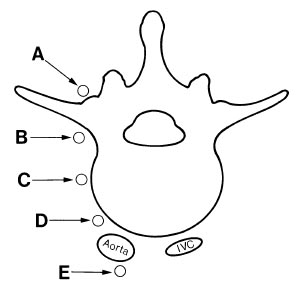
- A A
- B B
- C C
- D D
- E E
Answer:
D